Frt. Miguel Romo, SVD
From Church to Community Garden
By Frt. Miguel Romo, SVD
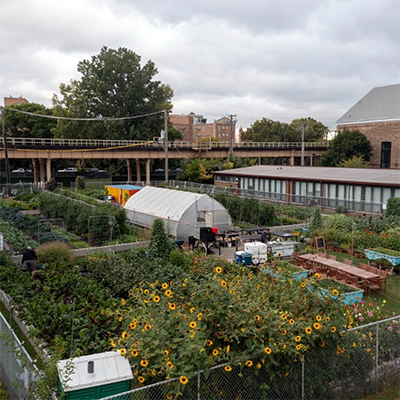
During the academic year, I’m committed to spending two days a week, four hours a day, volunteering at Just Roots Chicago. I truly enjoy the work, weeding rows of greens and checking tomatoes while the Green Line train runs overhead. It connects me with nature and gives me the opportunity to work with plants, which I really love. It gives me a chance to get my hands dirty and contribute to something real in the Bronzeville neighborhood.
I am volunteering for a nonprofit focused on food justice, but for me, this work is deeply connected to Justice, Peace, and the Integrity of Creation. To see why, you have to look at the history of the ground I am standing on.
For over 130 years, this half-acre plot at 29th and Wabash was the site of St. James Catholic Church. It was a massive limestone building, built by Irish immigrants in 1880, and later became a home for Black Catholics on the South Side. It was a "Mother Church" where people came every day to attend Mass. For generations, this was a place dedicated to feeding souls.
However, buildings do not last forever. After a fire in the 1970s and years of decline, the church had to be demolished in 2013, but the parish community did not leave. They moved their worship next door to the smaller parish hall, but the land where the big church stood sat empty for seven years.
In 2020, that changed. The site became the Just Roots St. James Community Farm. It is striking that the same land that once supported a building to feed souls is now generating food to feed bodies. The purpose of this holy ground has expanded. Where the altar used to be, we harvested close to 10,000 pounds of fresh produce last season.
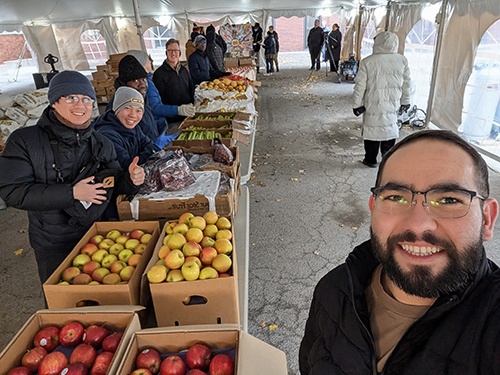
This effort requires hundreds of volunteers coming together, putting our hands in the dirt to make it happen. People come here for different reasons. Some are looking for a break from their office work, finding peace of mind, grounding their feet in nature. Others are looking for community, or just want to learn how to grow food. There is a strong sense of connection when we are all working the rows together. And the quality of what we produce is important. The food we give out is harvested within 24 hours of reaching the people. It is like an oasis in the middle of the city. Getting vegetables that fresh is rare, and it brings a real sense of dignity to the families who receive them.
Just Roots operates on a 50/50 model: half the harvest is sold through the CSA (Community Supported Agriculture) program to keep the farm running, and the other half is donated. A lot of that food goes directly to the St. James Food Pantry across the street.
The neighborhood has changed a lot over the years. Today, the clients at the food pantry are mostly elderly Chinese neighbors. It is amazing to see how this land, with its deep Catholic history, is now serving such a diverse group of people. We grow culturally relevant crops like bitter melon, eggplants, and hot peppers, but ultimately, we are just feeding our neighbors.
It is easy to see the loss of a church building as a sad ending or a failure. But standing here, at St. James, I realize that deconstruction does not have to mean the end of the mission. When the stones were removed, the holy ground was still there. We simply transitioned from a ministry that solely fed the spirit to one that uses the soil to feed the body and the spirit together. It gives me hope that God’s work is never finished, but simply changes shape, always finding new ways to bring life to our communities.