Frt. Thinh Cao
Being Present in Chaplaincy
By Frt. Thinh Cao, SVD
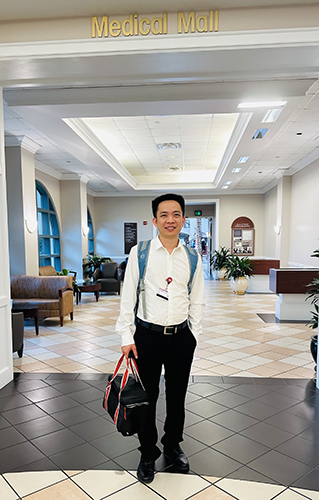
Hospital chaplaincy has been a transformative experience in my pastoral formation, especially since this ministry was not part of my earlier formation in Vietnam. Entering the hospital environment, I realized that I was stepping into a new garden, a sacred and unfamiliar space where human suffering, hope, fear, and longing coexist. In this garden, patients come from diverse faith traditions, cultures, and life experiences, and I am called to walk gently, with reverence, humility, and missionary openness.
This encounter has invited me to reflect more deeply on the theological meaning of being rather than doing in pastoral ministry. Christian faith is rooted in the mystery of the Incarnation: God does not save humanity from a distance but fully enters into human reality through Jesus Christ. As a missionary of the Society of the Divine Word (SVD), I understand ministry as entering new gardens where the Divine Word continues to take flesh. In the hospital setting, pastoral care becomes an incarnational presence, listening, accompanying, and remaining with others in their vulnerability, rather than trying to control or resolve their suffering.
Through Clinical Pastoral Education (CPE), I have come to recognize my natural tendency to rely on words, ideas, and solutions when encountering people in distress. Yet pastoral theology teaches that authentic ministry begins with listening. Without listening, I cannot truly honor the dignity of the other as a beloved child of God. One visit remains vivid in my memory:
I spent nearly forty minutes with a patient, offering nothing more than attentive presence. There were moments of silence, tears, and deep emotion. At the end of our time together, she thanked me, not for advice or even prayer, but for being there with her. In that moment, I realized that listening itself can be sacramental, a visible sign of God’s invisible grace.
This encounter deepened my understanding of the theology of kenosis, the selfemptying love of Christ described in Philippians 2:6–11. To be a chaplain is to empty oneself of the desire to fix, explain, or dominate the encounter, and instead to create space where God can quietly work within the other’s story. Through CPE, I have learned that being present is not a weakness but an openness, an openness that reflects the kenotic love of Christ and allows the Divine Word to be heard not through speech but through faithful accompaniment.
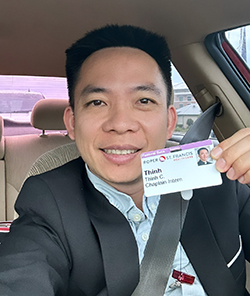
My CPE experiences at Lenox Hill Hospital in New York, St. Francis Hospital in South Carolina, and now at Sinai Hospital in Chicago have all reinforced this insight. Across these diverse settings, these new gardens, I have discovered that pastoral ministry is not measured by productivity or outcomes, but by faithfulness to presence. As a seminarian and SVD missionary, I continue to be formed to enter each new garden with trust, humility, and hope, allowing God to bring life where I am simply called to be.